Women in Higher Education: Access, Science and Leadership in Developing Countries
In one generation, women have gone from a minority to a majority of university students in much of the world. Yet the picture changes sharply by region, by subject and by rank: women remain under-represented in parts of Africa and South Asia, in engineering and computing, among researchers and at the top of universities. This guide sets out what the official data show and what has helped.
Access: a reversal, with exceptions
Data from the UNESCO Institute for Statistics (UIS) show that global female enrolment in tertiary education overtook male enrolment around the turn of the century, and the gap in women's favour has widened since. In Europe, North America, Latin America and the Caribbean and much of East Asia, women are now clearly the majority of students.
The exception is sub-Saharan Africa, where tertiary enrolment is low for everyone and women remain fewer than men in many countries. The reasons documented by UNESCO and the World Bank include lower completion of secondary school among girls, early marriage, household duties, the cost of fees and housing, and safety on the way to and on campus. Our article on higher education in Africa gives the wider context.
Subjects: the STEM gap
UNESCO's 2017 report Cracking the Code found that women accounted for about 35% of students enrolled in STEM-related fields of higher education worldwide, with the lowest shares in information and communication technology and in engineering. The pattern is visible in rich and poor countries alike, and it matters for development because many partnership programmes focus precisely on engineering, agriculture, health and technology.
| Indicator | Value | Source |
|---|---|---|
| Women among STEM higher education students, worldwide | About 35% | UNESCO, Cracking the Code (2017) |
| Women among researchers, worldwide | About 33% | UNESCO Science Report (2021) |
| SDG target 4.3 | Equal access for women and men to affordable, quality tertiary education by 2030 | United Nations |
Research and leadership: the leaky pipeline
Women's share falls at every step of the academic career. The UNESCO Science Report 2021 put women at about one in three researchers worldwide, and shares are lower still among full professors and in senior management. Studies by university associations in several regions find that only a minority of universities are led by women. The causes are similar across countries: career breaks, heavier caring responsibilities, fewer mentors and networks, bias in hiring and promotion, and in some places limited mobility for women to take up posts or fellowships abroad.
What programmes have tried
University partnerships and aid programmes have used a range of measures, often in combination:
- Targeted scholarships for women in under-represented fields, sometimes with quotas within broader scholarship schemes.
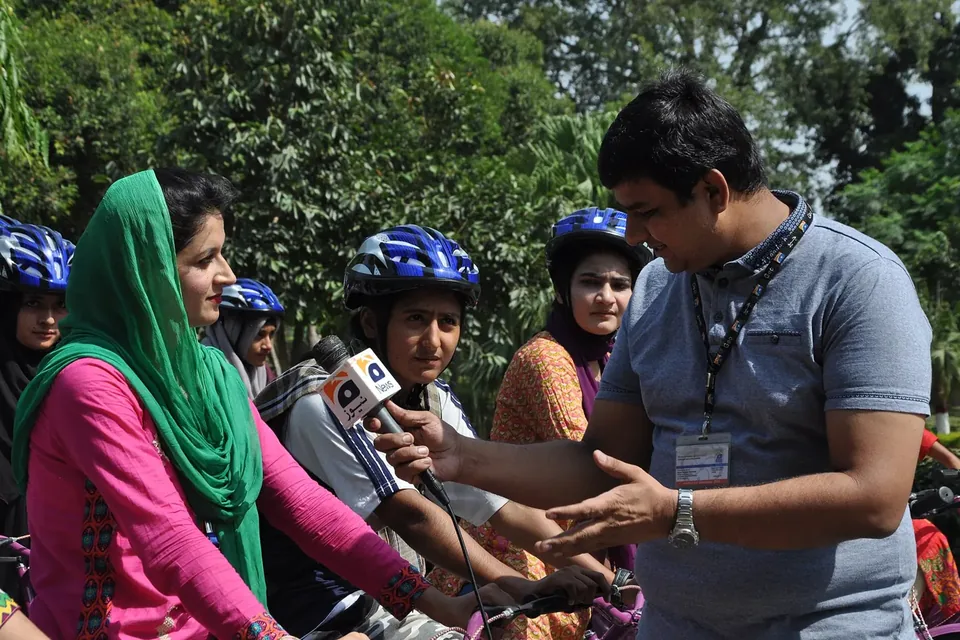
- Practical barriers: safe student housing for women, transport (the photograph above shows bicycles provided to students at an agricultural university in Pakistan), childcare and flexible schedules.
- Mentoring and networks linking women students and early-career researchers with senior women scientists, nationally and across borders.
- Leadership development for women academics and administrators, including training in management and fundraising.
- Institutional policies on sexual harassment, parental leave and transparent promotion, which some partnerships helped universities draft and adopt.
Evaluations generally find that scholarships alone raise enrolment but that completion and careers depend on the wider environment, which is why the more durable programmes also worked on policies and leadership. See how to evaluate a partnership for ways to tell the difference.
Opportunities for women students
Several international schemes give priority to, or are reserved for, women. Examples include the Organization for Women in Science for the Developing World (OWSD) PhD fellowships, hosted at institutions in the South, and the L'Oréal-UNESCO For Women in Science programme for researchers. Many general scholarships, such as those described in our guide to scholarships, also encourage applications from women in fields where they are under-represented. Eligibility and deadlines change every year, so always read the current call on the official site.
Why it matters for development
The World Bank and UNESCO link women's tertiary education with higher earnings, better health outcomes for families and a larger pool of skilled workers. In fields such as agriculture and health, where women are often the majority of farmers or frontline workers, having women among the researchers, extension officers and lecturers also changes which questions get asked. Closing the gaps in science and leadership is therefore not only a matter of fairness but of making partnerships more effective.
How to read gender data
UNESCO usually measures equality in enrolment with the gender parity index (GPI): the value of an indicator for women divided by its value for men. A GPI of 1 means parity; UNESCO treats values between 0.97 and 1.03 as parity, values below as a disadvantage for women and values above as a disadvantage for men. When comparing countries, check whether a figure is a ratio of enrolment rates or of student numbers, and which year it refers to, since data for some countries are several years old.
Sources
- UNESCO Institute for Statistics: uis.unesco.org.
- UNESCO, Cracking the Code: Girls' and Women's Education in STEM (2017).
- UNESCO, Science Report 2021.
- United Nations, Sustainable Development Goal 4.
- Organization for Women in Science for the Developing World: owsd.net.
- World Bank, tertiary education.
 Trends & data
Higher education in Africa
About one young person in ten enrolled, a fast-growing population, and new continental networks: the data and the debates.
 Partnerships
What university partnerships for development built
From India's first agricultural university to today's research networks: how cross-border university partnerships work, and what tends to last.
 Study abroad
Scholarships for international students
Fulbright, Chevening, Commonwealth, DAAD, Erasmus Mundus and more: who they fund, how selection works and how to avoid scams.